
Always know what’s in stock
Track every item across every location, with quantities automatically updated by your POS. See what’s running low and reorder before you run out.
See what you have, understand why quantities changed, and act on what needs attention - from one operational inventory system.
A complete inventory record for every item
.png)
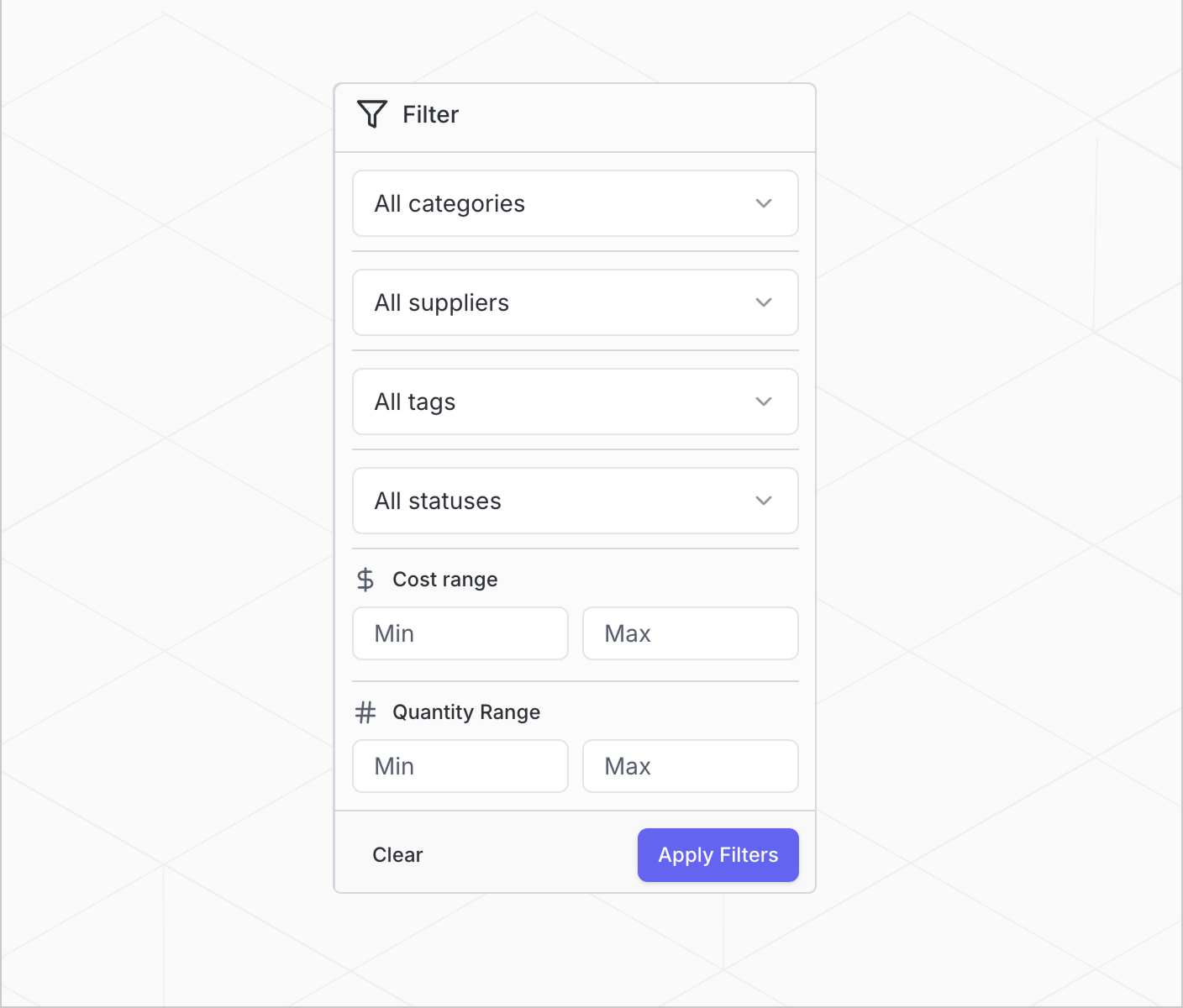
Search and filter inventory in seconds
Know what changed, what is low, and what to do next
.png)
Built for physical inventory
For teams that sell, consume, move, and reorder stock
Stash is designed for growing operators who need more control than a spreadsheet but do not want the weight of a traditional ERP.
One connected inventory workflow
Turn stock data into the next operational decision
Stash connects item records, stock movements, suppliers, purchasing, receiving, location transfers, POS sales data, and reorder signals so teams can work from shared inventory information.
Control every item
Track quantity, units, costs, prices, SKUs, barcodes, categories, tags, stock limits, suppliers, and storage locations.
Explore inventory control →02Purchase and receive
Create supplier-linked purchase orders for a destination, then receive complete or partial deliveries into inventory.
Explore purchase orders →03Plan around suppliers
Connect items to primary, secondary, backup, preferred, or alternative suppliers and record operational lead-time details.
Explore supplier management →04Move stock between locations
Draft, send, receive, partially receive, or cancel transfers while preserving the status of stock in motion.
Explore multi-location inventory →05Connect POS sales
Map POS products to inventory items or component blueprints so processed sales can support configured stock deductions.
Explore Square inventory workflows →06Review reorder signals
Use stock levels, sales or consumption data, supplier lead times, delivery schedules, and buffers to support replenishment decisions.
Explore inventory forecasting →Answers to your top questions
Stash brings together item-level inventory, location-level stock, suppliers, purchase orders, receiving, stock transfers, reorder signals, POS-connected data, and an auditable inventory ledger. Available capabilities can depend on plan, permissions, integrations, and workspace configuration.
Teams can work with location-level inventory and move stock through transfers that progress from draft to in transit, partially received, received, or cancelled. Sent and received quantities remain explicit so stock in motion does not disappear into a spreadsheet.
An item can include quantity, unit, cost and selling price, minimum and maximum stock, reorder quantity, SKU, barcode, category, tags, supplier links, brand, status, storage fields, dimensions, weight, pack size, and images. Teams can choose which columns they need to see.
Quantity changes preserve the previous amount, new amount, time, and business context. Movement categories include restock, consumption, adjustment, transfer in or out, waste, stocktake, return, correction, and opening stock. Notes and reason codes can document what happened.
Yes. Stash stores supplier contacts and operational details such as lead time, buffer days, delivery days, and minimum order value. Items can be linked to primary, secondary, backup, preferred, or alternative suppliers.
Teams can create purchase orders for a supplier and destination, select items, quantities, currency, and an expected delivery date, then update the order as needed. Deliveries can be received in full or partially, and inventory is updated from the quantities recorded as received.
Connected POS catalog, location, and order data can be mapped to Stash inventory. When product-to-item or component-blueprint mappings are configured, processed sales can support inventory deductions. Physical counts are still needed for waste, breakage, theft, and other movements a POS cannot observe.
Each item can have a low-stock threshold, and Stash can surface low-stock, critical, and out-of-stock states together with reorder alerts. Replenishment inputs can include stock, sales or consumption data, supplier lead times, delivery schedules, and buffers; operators should review suggestions before ordering.
Yes. Organization roles and permissions control access to areas such as reports, settings, purchase orders, transfers, blueprints, and cost data. Inventory and purchasing activity can retain the user and business context needed for operational accountability.
Start with the locations, item catalog, quantities and units, suppliers, stock thresholds, and integration or mapping details relevant to your workflow. Setup time depends on item count, data quality, number of locations, and operational complexity.
Run the full inventory workflow in one place.
Start a free trial. No credit card needed.


'%3e%3cg id='Final-Copy-2_2_' transform='translate(1275.000000, 200.000000)'%3e%3cpath class='st0' d='M7.4,12.8h6.8l3.1-11.6H7.4C4.2,1.2,1.6,3.8,1.6,7S4.2,12.8,7.4,12.8z'/%3e%3c/g%3e%3c/g%3e%3c/g%3e%3cg id='final---dec.11-2020'%3e%3cg id='_x30_208-our-toggle' transform='translate(-1275.000000, -200.000000)'%3e%3cg id='Final-Copy-2' transform='translate(1275.000000, 200.000000)'%3e%3cpath class='st1' d='M22.6,0H7.4c-3.9,0-7,3.1-7,7s3.1,7,7,7h15.2c3.9,0,7-3.1,7-7S26.4,0,22.6,0z M1.6,7c0-3.2,2.6-5.8,5.8-5.8h9.9l-3.1,11.6H7.4C4.2,12.8,1.6,10.2,1.6,7z'/%3e%3cpath id='x' class='st2' d='M24.6,4c0.2,0.2,0.2,0.6,0,0.8l0,0L22.5,7l2.2,2.2c0.2,0.2,0.2,0.6,0,0.8c-0.2,0.2-0.6,0.2-0.8,0l0,0l-2.2-2.2L19.5,10c-0.2,0.2-0.6,0.2-0.8,0c-0.2-0.2-0.2-0.6,0-0.8l0,0L20.8,7l-2.2-2.2c-0.2-0.2-0.2-0.6,0-0.8c0.2-0.2,0.6-0.2,0.8,0l0,0l2.2,2.2L23.8,4C24,3.8,24.4,3.8,24.6,4z'/%3e%3cpath id='y' class='st3' d='M12.7,4.1c0.2,0.2,0.3,0.6,0.1,0.8l0,0L8.6,9.8C8.5,9.9,8.4,10,8.3,10c-0.2,0.1-0.5,0.1-0.7-0.1l0,0L5.4,7.7c-0.2-0.2-0.2-0.6,0-0.8c0.2-0.2,0.6-0.2,0.8,0l0,0L8,8.6l3.8-4.5C12,3.9,12.4,3.9,12.7,4.1z'/%3e%3c/g%3e%3c/g%3e%3c/g%3e%3c/g%3e%3c/svg%3e) Your Privacy Choices
Your Privacy Choices